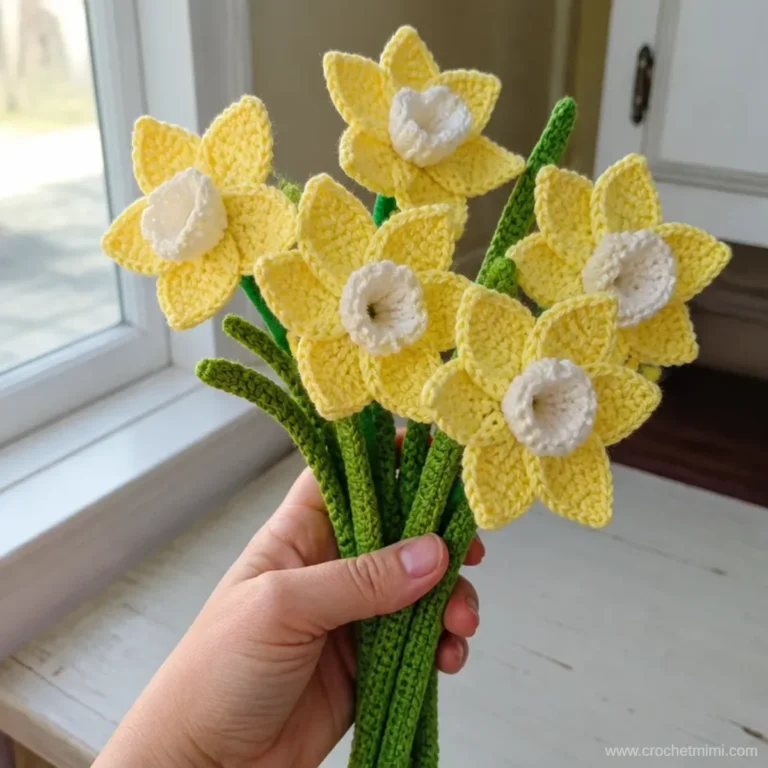

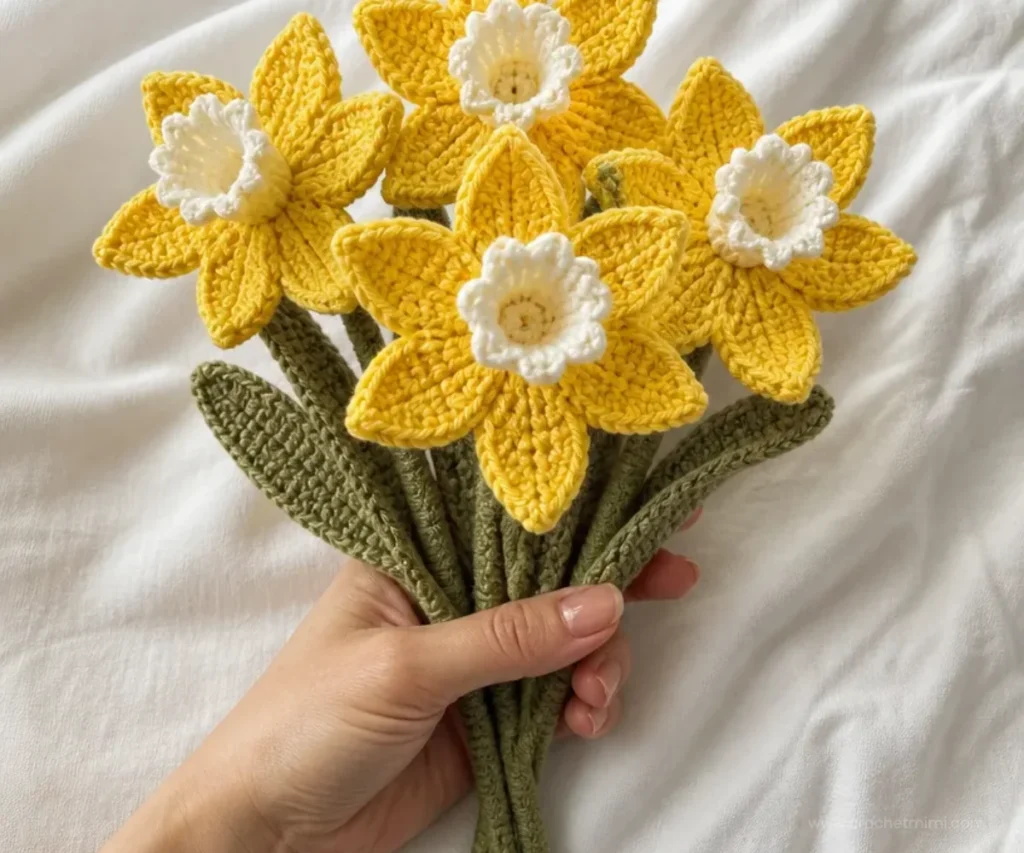
A cheerful daffodil bouquet brings the look of spring indoors without watering, wilting, or seasonal limits. This Daffodil Crochet Bouquet Pattern creates six yellow flowers with delicate eggshell trumpets, twelve sage-green leaves, and wired stems for arranging. It is a satisfying project for crocheters who enjoy floral shaping, textured details, and handmade home décor. Display the finished bouquet in a vase, give it as a lasting gift, or pair it with other floral projects such as this crochet daffodil bouquet idea for even more inspiration.
Why You’ll Love This Crochet Project
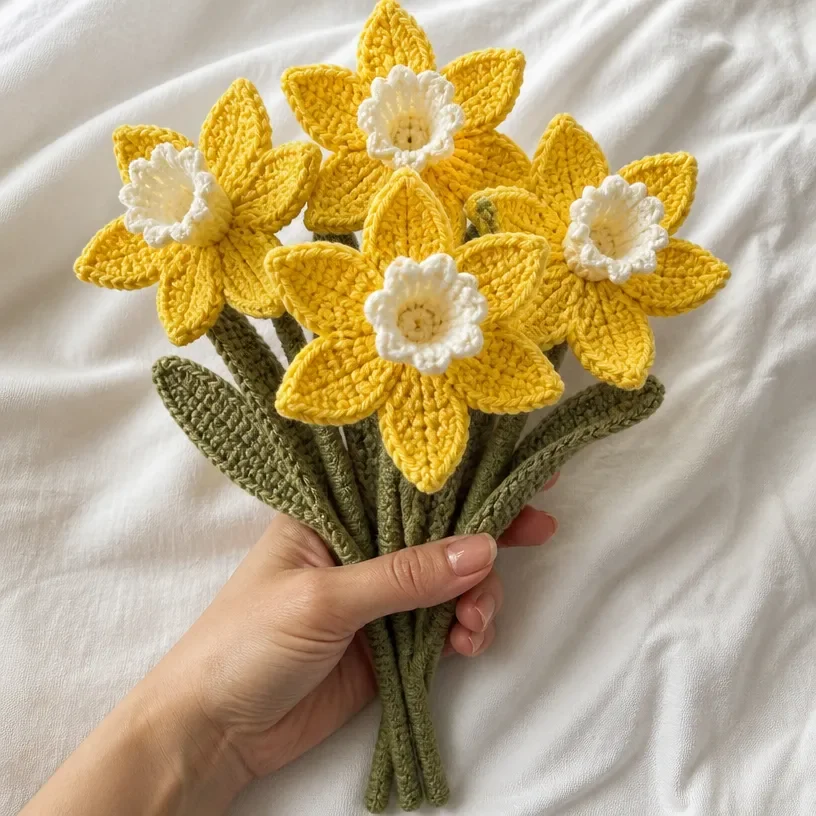
- It creates a complete bouquet. Six flowers and twelve leaves provide enough pieces for a small, coordinated arrangement.
- You’ll practice shaping techniques. The petals use increases, single-crochet decreases, slip stitches, and front- and back-loop work.
- The color combination feels fresh. Yellow petals, eggshell trumpets, and sage-green leaves closely echo a spring daffodil.
- It makes a lasting decoration. Once assembled, the wired flowers can be arranged and rearranged in a vase.
- It offers handmade gift potential. A crochet bouquet is suitable for birthdays, spring decorating, thank-you gifts, or a cheerful desk accent.
Crochet Mimi Tip: Make all six flowers before beginning assembly so you can compare their size and arrange the bouquet evenly.
Before You Start Crocheting
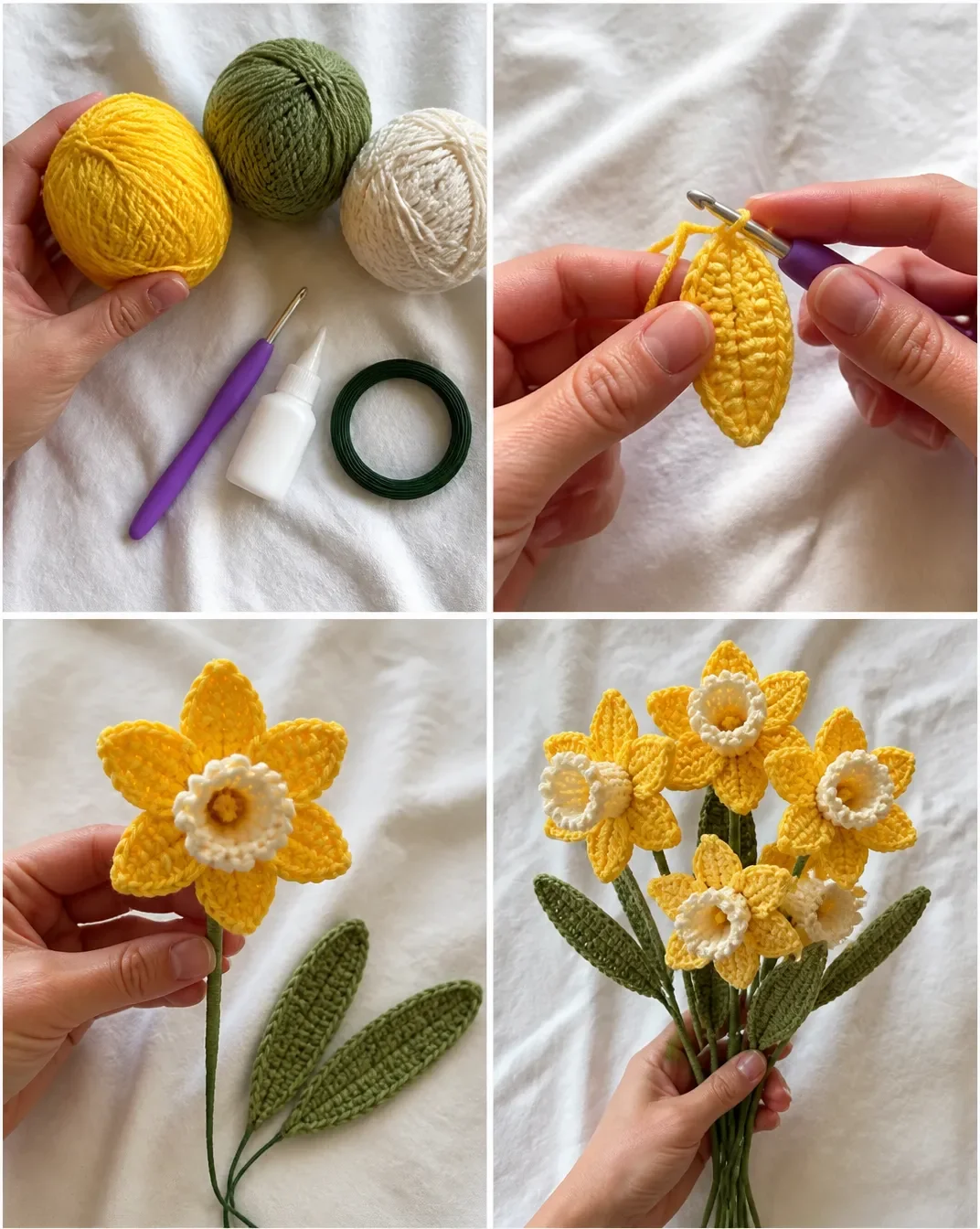
The project includes six daffodils, twelve leaves, and wired stems. Each flower begins with Color A and a small six-single-crochet center. Six petals are worked around that center, followed by a two-round trumpet in Color C. The leaves are worked separately in Color B and then attached during assembly.
The construction sequence is:
- Crochet six flowers in yellow.
- Add the eggshell trumpets.
- Crochet twelve sage-green leaves.
- Wrap the coated wire with Color B.
- Attach each flower and two leaves to a stem.
The pattern uses US crochet terminology. Helpful abbreviations include:
- ch: chain
- sc: single crochet
- hdc: half double crochet
- dc: double crochet
- sl st: slip stitch
- RS: right side
- yoh: yarn over
- sc dec: single-crochet decrease
For the trumpet, “front loop” means the loop closest to you when viewing the work from the front. For the petals, the pattern specifically directs you to work in back loops at several points, so check your loops carefully before inserting the hook.
If you enjoy extending a floral display with other handmade pieces, a blooming bouquet crochet blanket can complement a vase of crocheted flowers.
Materials You’ll Need
- Lily Sugar’n Cream 4-ply Worsted, 2.5 oz / 70.9 g (Solids):
- Color A, Yellow: 1 ball
- Color B, Sage Green: 1 ball
- Color C, Eggshell: 1 ball
- 4.00 mm (U.S. G or 6) crochet hook, or size needed to obtain gauge
- Glue
- Thread-coated wire
Color A forms the petals, Color C creates the trumpet, and Color B is used for both leaves and wire wrapping. The coated wire provides the structure needed to position the stems and flowers.
Complete Crochet Tutorial
Daffodil Flowers
Make 6.
With Color A, ch 2.
Flower Center
1st rnd:
(RS). 6 sc in 2nd ch from hook.
Join with sl st in back loop of first sc.
First Petal
1st row
Ch 1.
2 sc in back loop of same sc as last sl st.
Ch 1. Turn.
2nd row
2 sc in each sc. 4 sc.
Ch 1. Turn.
3rd to 5th rows
1 sc in each sc to end of row.
Ch 1. Turn.
6th row
(Draw up a loop in each of next 2 sc. Yoh and draw through 3 loops on hook sc dec made) twice.
Ch 3. Turn.
7th row
Miss first sc.
Sl st in next sc.
Sl st in inside of each of next 5 rows of petal.
Sl st in last sc worked on 1st row and in back loop of next sc.
Do not turn.
Second to Sixth Petals
1st row
Ch 1.
2 sc in back loop of same sc as last sl st.
Ch 1. Turn.
2nd to 7th rows
Work as given for 2nd to 7th rows of First Petal.
At end of Sixth Petal, fasten off.
Trumpet
Join Color C with sl st to any front loop of 1st rnd.
1st rnd
Ch 1.
2 sc in same sp as last sl st.
*2 sc in next front loop of sc. Rep from * around.
Join with sl st in first sc.
2nd rnd
Ch 1.
1 sc in same sp as last sl st.
*Ch 1. 1 sc in next sc. Rep from * around.
Join with sl st in first sc.
Fasten off.
The trumpet sits at the center of the flower and gives the daffodil its characteristic raised, ruffled appearance. Keep your stitches even so the trumpet remains open rather than pulling tightly inward.
Leaves
Make 12.
With Color B, ch 12.
1st rnd: RS
1 sc in 2nd ch from hook.
1 sc in next ch.
1 hdc in next ch.
1 dc in each of next 4 ch.
1 hdc in next ch.
1 sc in each of next 2 ch.
3 sc in last ch.
Working in other side of ch, proceed as follows:
1 sc in each of next 2 ch.
1 hdc in next ch.
1 dc in each of next 4 ch.
1 hdc in next ch.
1 sc in next ch.
2 sc in next ch.
Join with sl st to first sc.
Fasten off.
The three single crochets in the last chain turn the work smoothly around the tip. Avoid twisting the foundation chain as you work along its opposite side.
Assembly and Finishing
Wrap wire with Color B.
Glue yarn ends in place when done.
Thread wire through center of flower and twist the end of the wire into a tight spiral.
Glue back of flower to wire to secure.
Thread wire through point of two leaves and glue in position.
Handle the coated wire carefully while twisting it. After attaching the flowers, bend the stems gradually rather than making sharp kinks, which can weaken the covering or make the arrangement difficult to reposition.
Ways to Display Your Finished Crochet
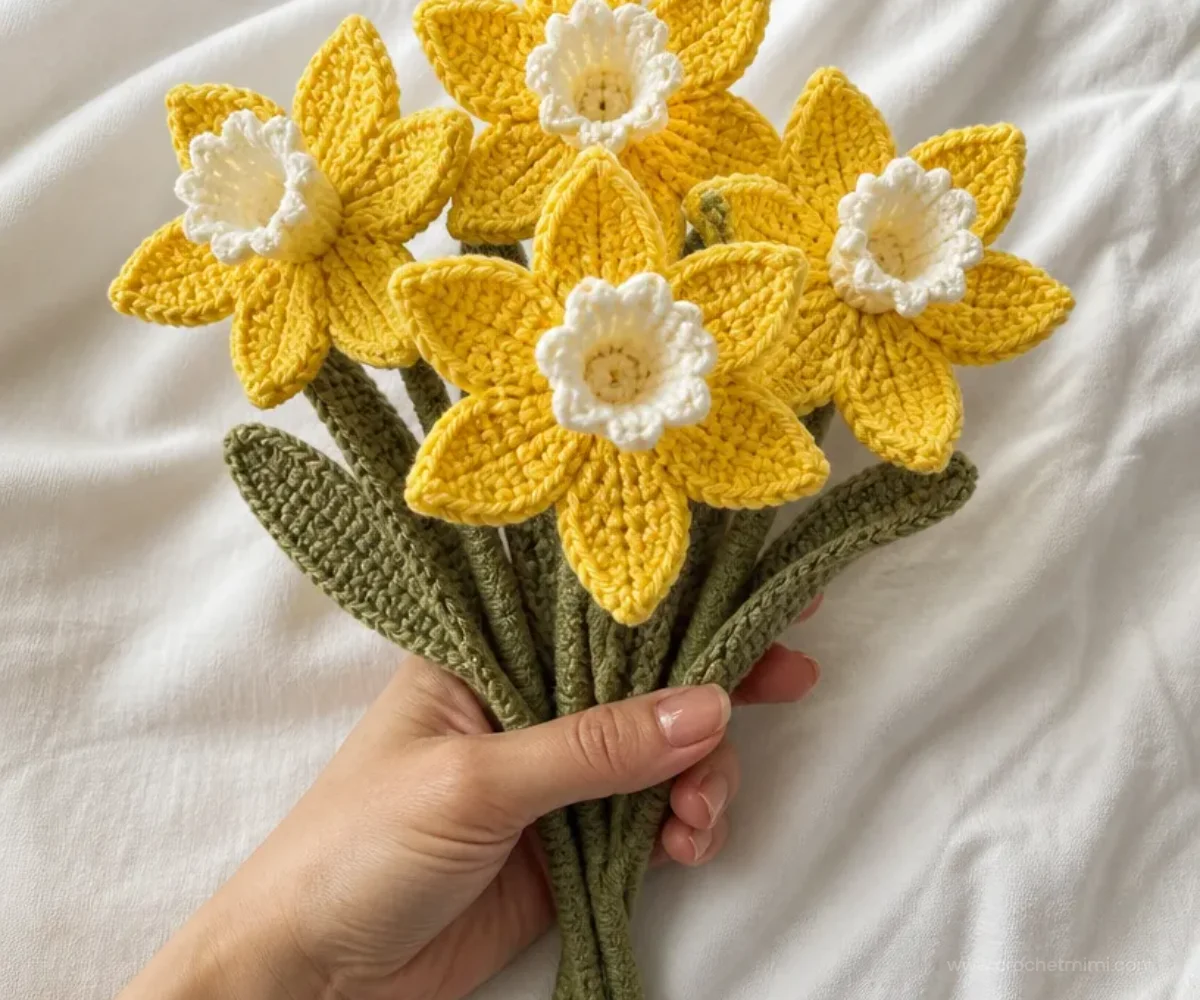
- Use a simple vase: Arrange the stems at different heights in a narrow glass or ceramic vase so each daffodil remains visible.
- Create a spring centerpiece: Place the bouquet in the middle of a dining or coffee table with a neutral table runner.
- Give a lasting floral gift: Wrap the stems together with ribbon or place the bouquet in a gift box tall enough to protect the petals.
- Build a seasonal arrangement: Combine the daffodils with other crocheted flowers in complementary colors for a fuller display.
- Decorate a workspace: A small group of stems can brighten a desk, shelf, or craft room without requiring sunlight.
- Style a handmade corner: Pair the bouquet with a floral textile project, such as a beginner-friendly crochet pansy bouquet, for varied flower shapes.
Caring for Your Crochet Project
Because this bouquet contains coated wire and glued components, keep it away from washing machines, soaking, and excessive moisture. Instead, dust the flowers gently with a soft, dry brush or use a cool air setting held at a distance.
For small marks, spot-clean the yarn carefully with a barely damp cloth, taking care not to saturate the trumpet, glue, or wire-covered stem. Allow the bouquet to dry fully in its arranged position.
Store the flowers upright or loosely wrapped in clean tissue paper. Avoid placing heavy objects on top of the petals, and keep the bouquet away from direct heat, hot windowsills, and areas where the glue could soften. If a petal shifts, reshape it gently with your fingers rather than pulling on the stitches.
Tips for Better Results
- Count the center stitches carefully. The first round must contain 6 sc, and the join is made in the back loop of the first sc.
- Watch the loop placement. Petal increases use the back loop, while the trumpet begins in front loops of the first round.
- Keep turning instructions exact. The repeated chain-1 turns help form the petal rows, while the final petal row specifically says, “Do not turn.”
- Make the decreases neatly. For the sixth petal row, draw up a loop in each of the next 2 sc, yarn over, and draw through 3 loops to make each sc dec.
- Keep the leaves symmetrical. Work along the first side of the chain, turn around the final chain with 3 sc, then continue along the other side.
- Secure yarn ends before arranging. Glue the yarn ends in place as directed, but use only enough glue to hold them securely without creating visible stiff spots.
- Attach two leaves to each stem. Position the leaves at slightly different angles so the bouquet looks natural.
- Bend stems after the glue sets. This reduces the chance of shifting the flowers or loosening the leaf attachments.
For another flower-focused project with a different silhouette, the daisy bouquet crochet pattern tutorial offers a useful comparison for arranging crocheted blooms.
Color and Styling Variations
The approved pattern uses yellow petals, eggshell trumpets, and sage-green leaves, but you can personalize the finished bouquet without changing the construction.
- Try a softer spring palette: Use pale yellow for the petals and a light cream shade for the trumpets.
- Create a bold display: Choose a deeper golden color for Color A and keep the eggshell trumpet for contrast.
- Coordinate with home décor: Match the petal color to a favorite vase, table runner, or room accent.
- Use seasonal combinations: Yellow and green suit spring, while cream and muted green can create a year-round neutral arrangement.
- Change the vase style: A narrow bud vase emphasizes the individual stems, while a wider container creates a fuller bouquet.
- Combine flower designs: Add crocheted daisies or pansies for a mixed arrangement, using compatible yarn textures when possible.
Optional yarn or hook changes may affect the size, firmness, stitch definition, and amount of yarn required. If you substitute materials, make a sample first and remember that a different yarn may also change how securely the wire supports the flowers.
Frequently Asked Questions
Is this project suitable for a beginner?
It can suit a beginner who is comfortable with chains, single crochet, half double crochet, double crochet, slip stitches, turning rows, and working in specific loops. The petal shaping requires careful attention to the row instructions.
How many flowers does the pattern make?
The pattern directs you to make 6 daffodils. It also includes 12 leaves, allowing two leaves to be attached to each flower stem.
What yarn colors are used?
Color A is Yellow, Color B is Sage Green, and Color C is Eggshell. Color A is used for the flowers, Color C for the trumpets, and Color B for the leaves and wrapped wire.
What crochet hook size is required?
Use a 4.00 mm crochet hook, listed as U.S. G or 6, or use the size needed to obtain gauge.
Can I change the flower colors?
Yes. Changing colors is an optional styling choice. Keep the component assignments the same if you want the construction to remain unchanged, and remember that different yarns or colors may vary in thickness and texture.
How are the flowers attached to the stems?
Wrap the wire with Color B, thread it through the center of the flower, twist the wire end into a tight spiral, and glue the back of the flower to the wire. Then thread the wire through the point of two leaves and glue them in position.
Can I wash the finished bouquet?
Do not machine wash or soak the finished bouquet because it contains coated wire and glued components. Dust gently and spot-clean only when necessary.
How can I keep the bouquet looking neat?
Store it away from moisture, heat, and heavy pressure. Arrange the stems gently, reshape the petals by hand, and keep the flowers upright or protected with loose tissue paper when not displayed.
Is there another daisy arrangement to explore?
Yes, a separate easy crochet daisy bouquet tutorial can provide another direction for building a handmade floral display.
Conclusion
This Daffodil Crochet Bouquet Pattern combines shaped petals, contrasting trumpets, leafy stems, and simple wire assembly into a cheerful handmade decoration. Make the six-flower bouquet as written, or adapt the colors and display style to suit the season. For additional daffodil inspiration, compare this free crochet daffodil flower pattern and this daffodil wall-bouquet pattern.