
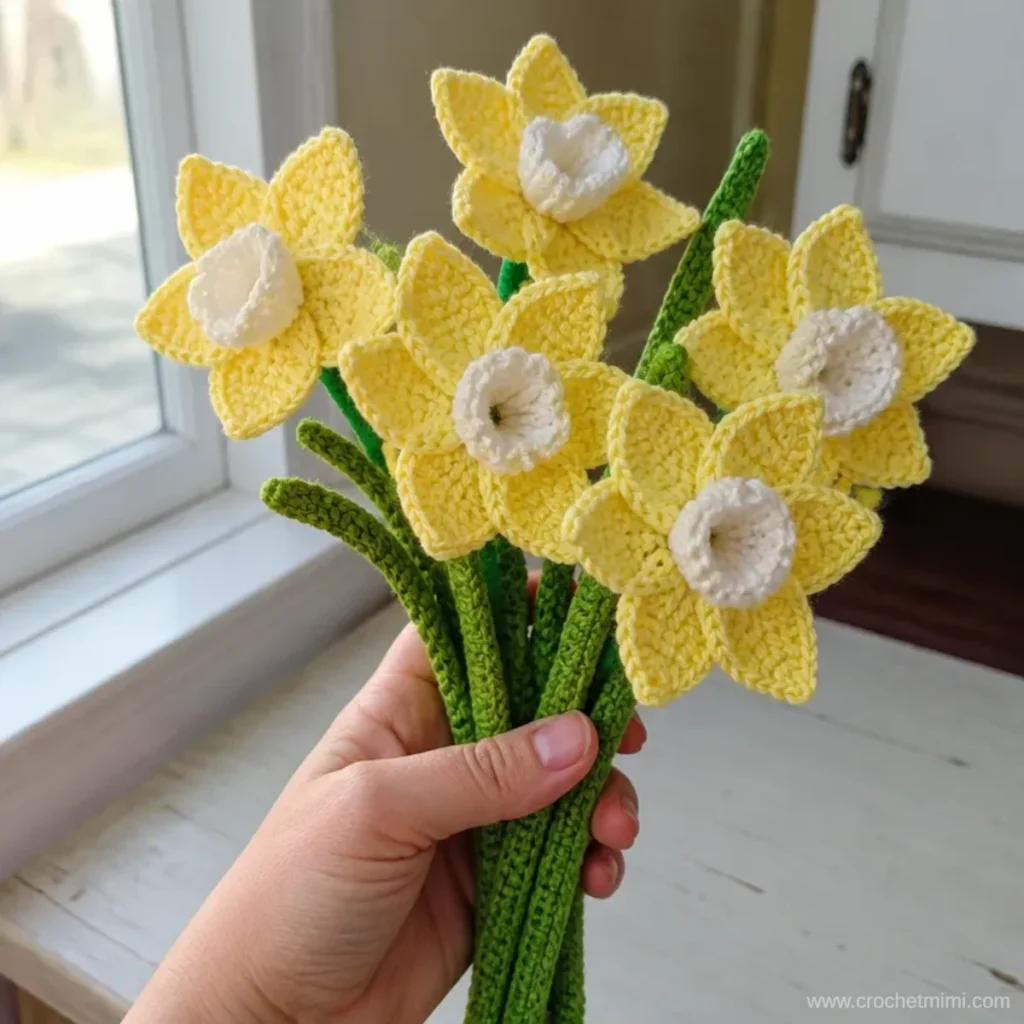
A daffodil crochet bouquet brings cheerful spring color to your home without watering or wilting. This pattern makes six sunny yellow daffodils with white trumpet centers, green leaves, and flexible crocheted stems supported by floral wire. The finished bouquet works beautifully in a vase, as a handmade gift, or as part of a seasonal display. For help coordinating shades across a larger arrangement, use this crochet bouquet color planning guide before choosing additional flowers.
Why You’ll Love This Crochet Project
- It creates a complete bouquet: You will make six daffodils, three leaves, and six stems for a coordinated floral arrangement.
- It practices shaping: The petal increases, decreases, and slip-stitch edging create a recognizable daffodil silhouette.
- It makes a lasting decoration: Unlike fresh flowers, this bouquet can be displayed season after season.
- It offers handmade gift potential: A crocheted bouquet is suitable for spring birthdays, housewarmings, Mother’s Day, and floral-themed gifts.
- It encourages color creativity: The approved palette uses pale yellow, white, and hot green, but the same construction can support other seasonal combinations.
Crochet Mimi Tip: Make the flowers first, then arrange the stems and leaves before gluing anything permanently. This lets you balance the bouquet naturally.
Before You Start Crocheting
The bouquet is built in a clear sequence. First, make six daffodils in pale yellow, adding six-petal flower shapes around the original six hdc foundation. Next, crochet a white trumpet onto the front loops of each flower. Make three hot-green leaves, then six wire-supported stems. Finally, attach each flower to a folded stem and group the stems with the leaves.
The pattern uses US crochet terminology and includes working in front and back loops, crocheting over floral wire, increases, decreases, slip stitches, and joined rounds. The supplied hook is a U.S. G/6 (4 mm) crochet hook, or use the size needed to obtain gauge.
Abbreviations
- ch: chain
- hdc: half double crochet
- sc: single crochet
- sc2tog: single crochet two stitches together
- sl st: slip stitch
- rnd: round
- RS: right side
- rem: remaining
- tog: together
- yoh: yarn over hook
Materials You’ll Need
- Bernat® Handicrafter® Cotton, 1.75 oz/50 g; 80 yds/73 m:
- Main Color (MC) Hot Green (01712): 3 balls
- Contrast A Pale Yellow (01030): 2 balls
- Contrast B White (01001): 1 ball
- Size U.S. G/6 (4 mm) crochet hook or size needed to obtain gauge
- Light green floral wire
- Hot glue gun
The floral wire supports the six stems, while the hot glue attaches each crocheted flower to the folded end of its stem.
Complete Crochet Instructions
Daffodils
Make 6.
With A, ch 3.
1st rnd: (RS). 6 hdc in 3rd ch from hook. Join with sl st in back loop of first hdc.
First Petal
1st row: Ch 1. 2 sc in back loop of same sp as last sl st. Ch 1. Turn.
2nd row: Ch 1. 2 sc in each sc to end of row. 4 sc. Turn.
3rd to 5th rows: 1 sc in each sc to end of row. Ch 1. Turn.
6th row: (Draw up a loop in each of next 2 sc. Yoh and draw through 3 loops on hook sc2tog made) twice. Turn.
7th row: Ch 3. Skip first sc. Sl st in next sc. Sl st in side of each of next 5 rows of Petal. Sl st in last sc worked on 1st row and in back loop of next hdc. Do not turn.
Second to Sixth Petals
1st row: Ch 1. 2 sc in back loop of same hdc as last sl st. Ch 1. Turn.
2nd to 7th rows: Work as given for 2nd to 7th rows of First Petal.
At end of Sixth Petal, fasten off.
Trumpet
Join B with sl st to any front loop of 1st rnd.
1st rnd: Ch 1. 2 sc in same sp as sl st.
*2 sc in next front loop of sc. Rep from * around. Join with sl st in first sc.
2nd and 3rd rnds: Ch 1. 1 sc in same sp as sl st.
1 sc in each sc around. Join with sl st in first sc. Fasten off at end of 3rd rnd.
Leaves
Make 3.
With MC, ch 6.
1st row: 1 sc in 2nd ch from hook. 1 sc in each ch to end of ch. 5 sc. Turn.
2nd and 3rd rows: Ch 1. 1 sc in each sc to end of row. Turn.
4th row: Ch 1. 1 sc in each of first 2 sc. 3 sc in next sc. 1 sc in each sc to end of row. 7 sc. Turn.
5th and 6th rows: Ch 1. 1 sc in each sc to end of row. Turn.
7th row: Ch 1. 1 sc in each of first 3 sc. 3 sc in next sc. 1 sc in each sc to end of row. 9 sc. Turn.
8th and 9th rows: Ch 1. 1 sc in each sc to end of row. Turn.
10th row: Ch 1. 1 sc in each of first 4 sc. 3 sc in next sc. 1 sc in each sc to end of row. 11 sc. Turn.
11th to 14th rows: Ch 1. 1 sc in each sc to end of row. Turn.
15th row: Ch 1. Sc2tog. 1 sc in each sc to last 2 sts. Sc2tog. Turn.
16th to 18th rows: Ch 1. 1 sc in each sc to end of row. Turn.
Rep 15th to 18th rows until 3 sts rem. Fasten off.
Stems
Make 6.
Cut floral wire each 7″ [18 cm] long.
With MC, ch 27.
1st row: 1 sc in 2nd ch from hook. Align floral wire with chain made. Working over floral wire, 1 sc in each ch to end of ch. Fasten off.
Work carefully while crocheting over the wire so it remains centered inside the stem. Bend each finished wire gently rather than making sharp creases.
Assembly and Finishing
Daffodil Bouquet: Glue Daffodil to folded end of stem. Holding 2 stems tog, Wrap leaf around stems. Wind MC around wrapped leaf at base of Bouquet. Secure yarn.
For additional floral inspiration, compare the structure of this project with the crochet bridal rose bouquet when planning a mixed handmade arrangement.
Ways to Display Your Finished Crochet
- Arrange the flowers in a small vase. Curve the wire-supported stems at slightly different heights so all six daffodils remain visible.
- Create a spring centerpiece. Place the bouquet in the middle of a dining or coffee table with a simple neutral container.
- Give it as a lasting floral gift. The bouquet can be wrapped in tissue paper or placed in a decorative vessel before gifting.
- Use it in a seasonal display. Pair the yellow and white flowers with spring décor, pastel textiles, or natural wood accents.
- Build a larger crochet arrangement. Add other handmade flowers, such as a crochet daisy bouquet, while keeping the daffodils as the bright focal flowers.
Caring for Your Crochet Project
- Dust the bouquet gently with a soft, dry cloth, makeup brush, or gentle bursts of cool air.
- If a small area becomes soiled, use careful spot cleaning with minimal moisture and avoid soaking the flowers.
- Do not machine wash the bouquet because it contains floral wire and hot-glued components.
- Keep the arrangement away from excessive heat, which can soften or weaken the adhesive.
- Store the bouquet upright or loosely protected so the petals and trumpet do not become crushed.
- Reshape the wire-supported stems gently whenever you change the arrangement.
- Keep the project in a dry place away from prolonged direct sunlight to help preserve the yarn colors.
Tips for Better Results
- Mark the first hdc if needed. The flower begins with six hdc in the third chain from the hook, and identifying the first stitch can make the back-loop join easier to see.
- Pay close attention to loop placement. The petals begin in back loops, while the trumpet is joined to the front loops of the first round.
- Count the petal rows. Each petal has a specific sequence of increases, straight rows, decreases, and slip stitches. Losing a row can change the petal shape.
- Keep the petal tension even. Loose stitches may make the petals floppy, while very tight stitches can make the edging difficult to work.
- Check each leaf count. The increases create stitch counts of 7, 9, and 11 sc at the specified points before the decrease section begins.
- Center the wire before crocheting over it. Align it with the chain and keep it enclosed as you work the sc stitches across the row.
- Test the bouquet arrangement before gluing. Position the flower heads, leaves, and stems first so the final silhouette feels balanced.
- Secure yarn ends neatly. The assembly instructions call for winding MC around the wrapped leaf at the base of the bouquet; keep this wrap firm and tidy.
Color and Styling Variations
These ideas are optional and do not change the approved pattern instructions.
- Try a different petal shade: Replace Pale Yellow with another flower color for a softer cream bouquet or a stronger golden arrangement. Changing yarn may affect texture, stitch definition, and yarn requirements.
- Use a coordinated trumpet: White creates clear contrast, while a pale cream or deeper yellow could produce a more monochromatic flower.
- Plan a mixed bouquet: Use the daffodils as the central color and add flowers in related spring shades. A color plan can help prevent the arrangement from becoming visually crowded.
- Adjust the vase style: A narrow glass vase emphasizes the stems, while a ceramic container creates a fuller, more compact presentation.
- Shape the stems differently: The floral wire allows gentle variations in height and direction, but avoid sharp bends that could strain the crocheted covering.
- Coordinate the greenery: Keep the hot-green leaves as written for a traditional look, or use a compatible green shade if making optional additional foliage. A color or yarn change may alter the visual balance of the bouquet.
Frequently Asked Questions
Is this daffodil crochet bouquet pattern beginner-friendly?
It is suitable for crocheters who are comfortable with basic US stitches and ready to practice increases, decreases, front-loop and back-loop work, joined rounds, and crocheting over wire. The petal shaping requires careful row counting.
How many daffodils does the pattern make?
The pattern directs you to make 6 daffodils. It also includes 3 leaves and 6 stems for the bouquet assembly.
What yarn is recommended?
The approved yarn is Bernat® Handicrafter® Cotton in the listed colors and quantities: three balls of Hot Green, two balls of Pale Yellow, and one ball of White. A substitution is possible, but yarn changes may affect texture, size, shaping, and the amount required.
What hook size should I use?
Use a size U.S. G/6 (4 mm) crochet hook or the size needed to obtain gauge.
Can I change the flower colors?
Yes. Color changes are an optional styling choice. Keep the construction instructions the same, and remember that changing colors does not automatically change the required stitch counts or shaping.
How are the stems made?
Each stem uses a 7″ [18 cm] length of floral wire and a chain of 27 worked in MC. The first sc is made in the second chain from the hook, then the remaining sc stitches are worked over the aligned floral wire.
How are the flowers attached?
The assembly instructions direct you to glue each Daffodil to the folded end of its stem. Then hold two stems together, wrap a leaf around them, wind MC around the wrapped leaf at the base of the bouquet, and secure the yarn.
Can the finished bouquet be washed?
Because the bouquet contains floral wire and hot glue, do not machine wash or soak it. Use gentle dusting and careful spot cleaning instead.
How can I keep the bouquet in shape?
Use the wire-supported stems to make gentle adjustments, arrange the flower heads before final display, and store the bouquet where the petals and trumpet will not be crushed.
Conclusion
This daffodil crochet bouquet combines sunny flowers, crisp white trumpets, green leaves, and flexible stems into a cheerful handmade display. Once you finish the six flowers, you can arrange them in a vase, give them as a lasting gift, or coordinate them with other crochet blooms. For more daffodil inspiration, explore this free crochet daffodil flower pattern and this daffodil pattern for a wall bouquet.