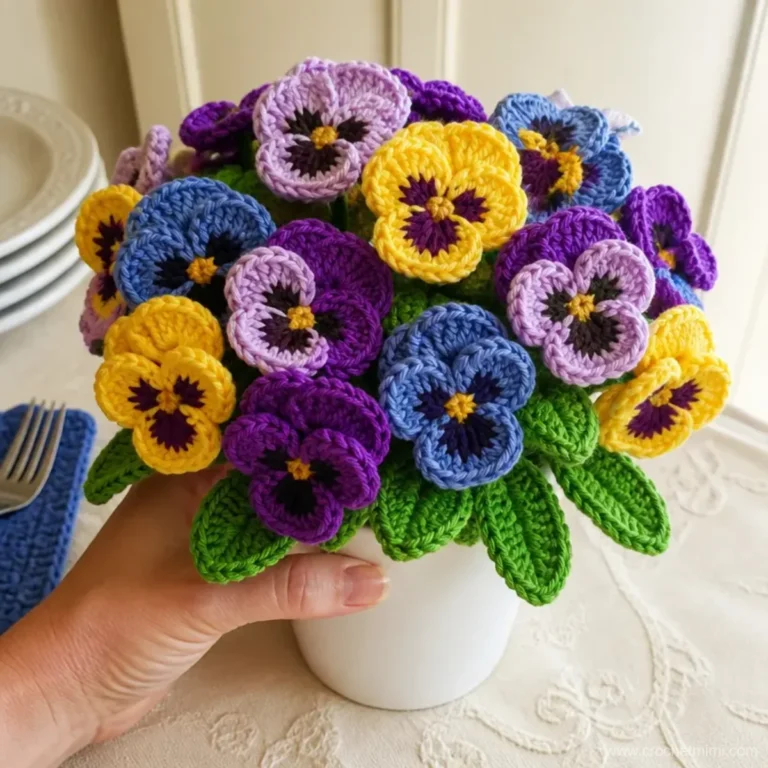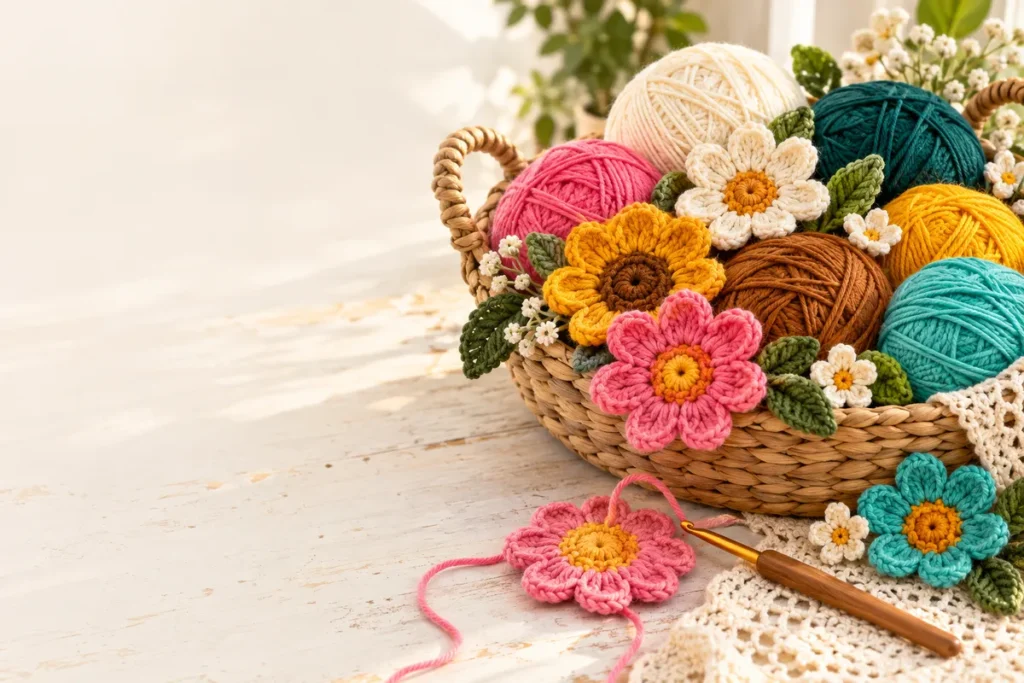

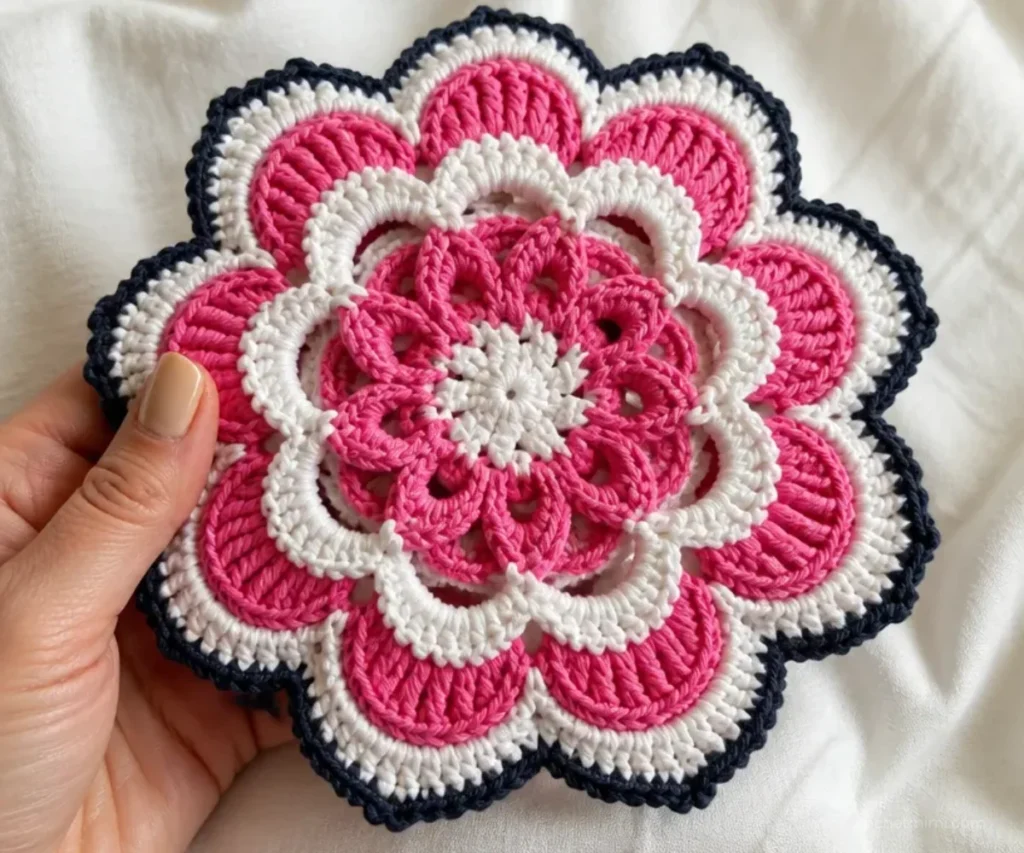
A layered crochet flower is a wonderful way to practice shaping, picots, color changes, and raised petals while creating a decorative handmade bloom. This crochet flower pattern uses Patons® Grace in snow, rose, and night to build five-petal layers with an elegant contrasting edge. Display the finished flower in a small arrangement, use it as a gift embellishment, or combine it with other designs such as these crochet bell flower ideas for a fuller botanical display.
Why You’ll Love This Crochet Project
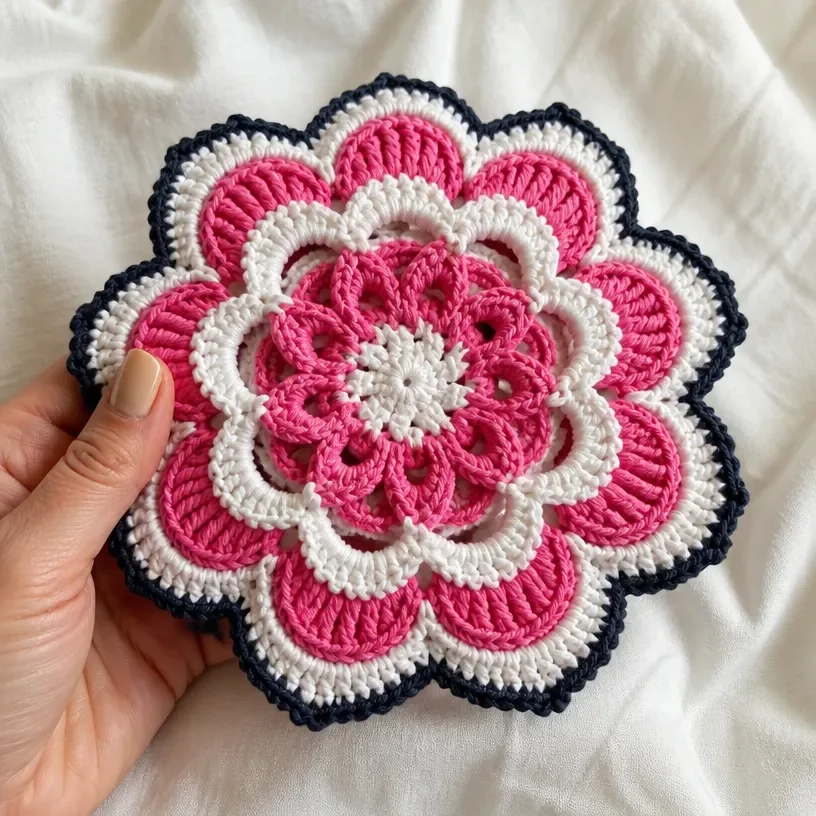
- It creates layered dimension. Several rounds of petals are worked behind earlier rounds, giving the flower a full, ruffled appearance.
- It practices useful techniques. You will work chains, half double crochet, single crochet, double crochet, treble crochet, picots, slip stitches, and color changes.
- It makes a flexible decoration. The finished flower can stand alone, decorate wrapped gifts, or become part of a larger floral display.
- The color changes add definition. Snow and rose create the main bloom, while Night outlines the edge and helps the petal shape stand out.
- It suits creative arrangements. Pairing this flower with other handmade blooms, such as a crochet daffodil bouquet, can create a cheerful mixed-flower display.
Crochet Mimi Tip: Keep each petal layer relaxed as you work. Tight tension can make the flower curl inward instead of opening naturally.
Before You Start Crocheting
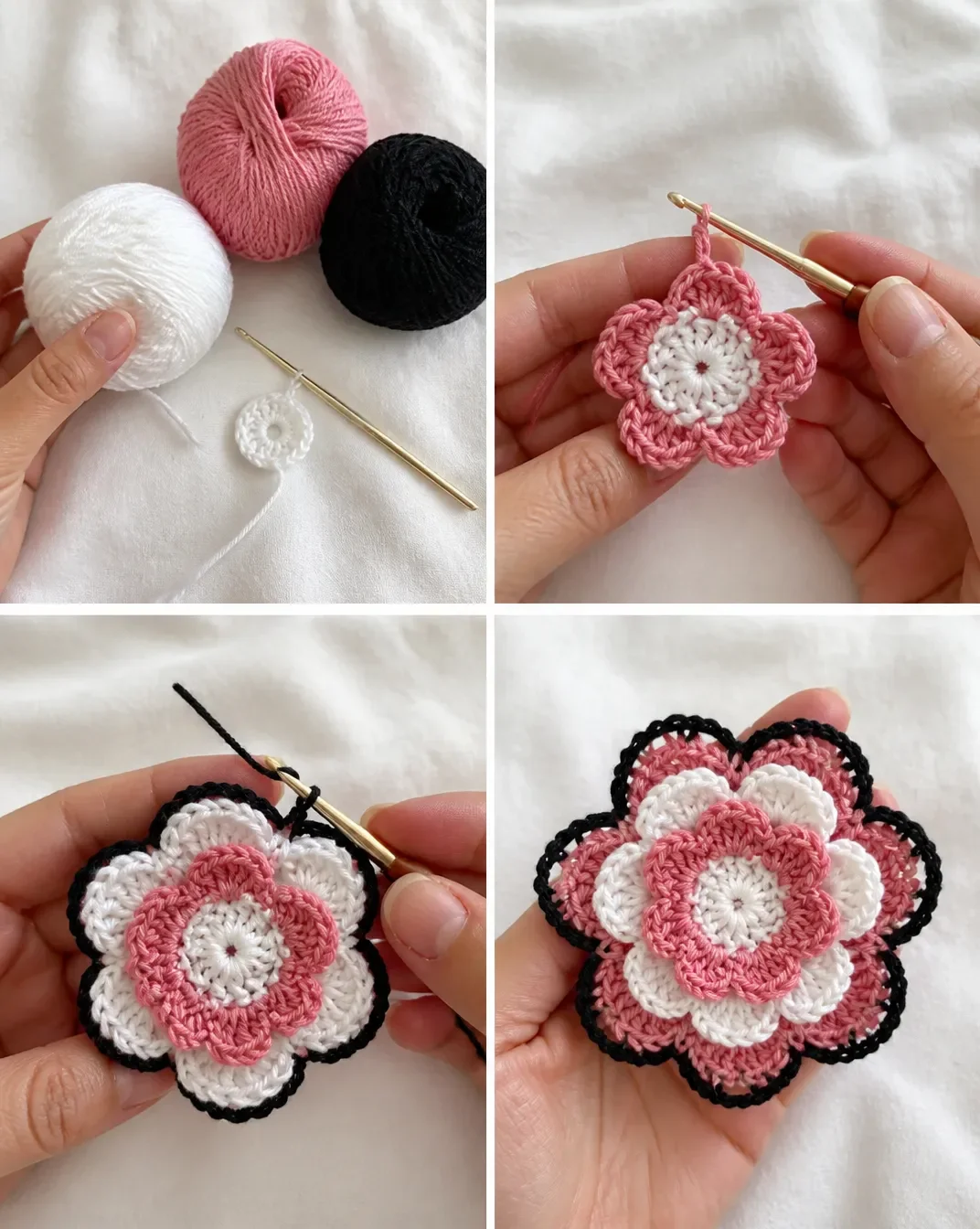
This pattern creates one layered five-petal crochet flower. The center begins with a small ring and five foundation spaces. Petal layers are then built progressively, with chain spaces worked behind the previous layer to support larger petals.
The construction follows this sequence:
- Make the center ring and establish the first five spaces.
- Add the small inner petal structure.
- Work the first visible petal layer in Contrast A.
- Create a larger petal layer in MC.
- Continue alternating colors and increasing the height and width of the petals.
- Finish with a contrasting single-crochet edging.
- Repeat the final petal rounds as directed for the remaining petals.
The pattern uses these common US crochet abbreviations:
- ch: chain
- sc: single crochet
- hdc: half double crochet
- dc: double crochet
- tr: treble crochet
- sl st: slip stitch
- rnd: round
- sp: space
- rep: repeat
- MC: Main Color
When an instruction says that a beginning chain does not count as a stitch, do not include it in the stitch placement or final count.
Materials You’ll Need
- Patons® Grace, 50 g/1.75 oz
- Main Color (MC), 60005 Snow: 1 ball
- Contrast A, 60437 Rose: 1 ball
- Contrast B, 60040 Night: 1 ball
The pattern information supplied here does not specify a crochet hook size or additional construction supplies, so use the hook and tools designated by your approved pattern source if they are provided separately.
Complete Crochet Instructions
Starting and Center
Starting
With MC, ch 3. Join with sl st to form a ring.
1st rnd
Ch 1.
10 hdc in ring.
Join with sl st to first hdc.
(No explicit stitch count given; follow as written.)
2nd rnd
Ch 1.
1 sc in same sp as last sl st.
Ch 3. Sl st in 3rd ch from hook – Picot made.
Miss next sc.
1 sc in next sc.
Rep from * 3 times more.
Picot.
Miss last sc.
Join with sl st to first sc.
3rd rnd
Ch 1.
Working behind Picot, 1 sc in next missed sc of 2nd rnd.
Ch 2.
Rep from * 4 times more.
Join with sl st to first sc.
5 Petals.
Fasten off.
First Petal Layer
4th rnd
Join A with sl st to any ch-2 sp.
Ch 1.
(1 sc. 4 dc. 1 sc) in same sp.
[(1 sc. 4 dc. 1 sc) in next ch-2 sp] 4 times.
Join with sl st to first sc.
5 Petals.
5th rnd
Ch 2 (does not count as st).
Working from back to front behind last rnd, 1 sc in next ch-2 sp of 3rd rnd between center 2 dc.
Ch 3.
Rep from * 4 times more.
Miss first ch-2 sp.
Join with sl st to next sc.
Fasten off.
The single crochet stitches in this round anchor the next petal layer behind the petals just completed. Work carefully from back to front so the new chain spaces remain visible.
Second Petal Layer
6th rnd
Join MC with sl st to any ch-3 sp.
Ch 1.
(1 sc. 6 dc. 1 sc) in same sp.
[(1 sc. 6 dc. 1 sc) in next ch-3 sp] 4 times.
Join with sl st to first sc.
5 Petals.
7th rnd
Ch 3 (does not count as st).
Working from back to front behind last rnd, 1 sc in next ch-3 sp of 5th rnd between center 2 dc.
Ch 4.
Rep from * 4 times more.
Miss first ch 3.
Join with sl st to next sc.
Fasten off.
Third Petal Layer
8th rnd
Join A with sl st to any ch-4 sp.
Ch 1.
(1 sc. 1 dc. 4 tr. 1 dc. 1 sc) in same ch-4 sp.
[(1 sc. 1 dc. 4 tr. 1 dc. 1 sc) in next ch-4 sp] 4 times.
Join with sl st to first sc.
5 Petals.
9th rnd
Ch 3 (does not count as st).
Working from back to front behind last rnd, 1 sc in ch-4 sp of 7th rnd between center 2 tr.
Ch 5.
Rep from * 4 times more.
Miss first ch 3.
Join with sl st to next sc.
Fasten off.
Final Petal Layer
10th rnd
Join MC with sl st to any ch-5 sp.
Ch 1.
(1 sc. 2 dc. 6 tr. 2 dc. 1 sc) in same ch-5 sp.
[(1 sc. 2 dc. 6 tr. 2 dc. 1 sc) in next ch-5 sp] 4 times.
Join with sl st to first sc.
Fasten off.
5 Petals.
Edging
Join B with sl st to any sc of 4th rnd.
Work 1 sc in every st around edge of petals.
Join with sl st to first sc.
Fasten off.
Repeats / Petals
Rep for rem petals on rnds 6, 8 and 10.
As you repeat the remaining petal rounds, check that each new petal is positioned evenly around the flower. The chain spaces from the earlier rounds are the foundation for the taller outer petals.
Creative Ways to Use Your Finished Crochet
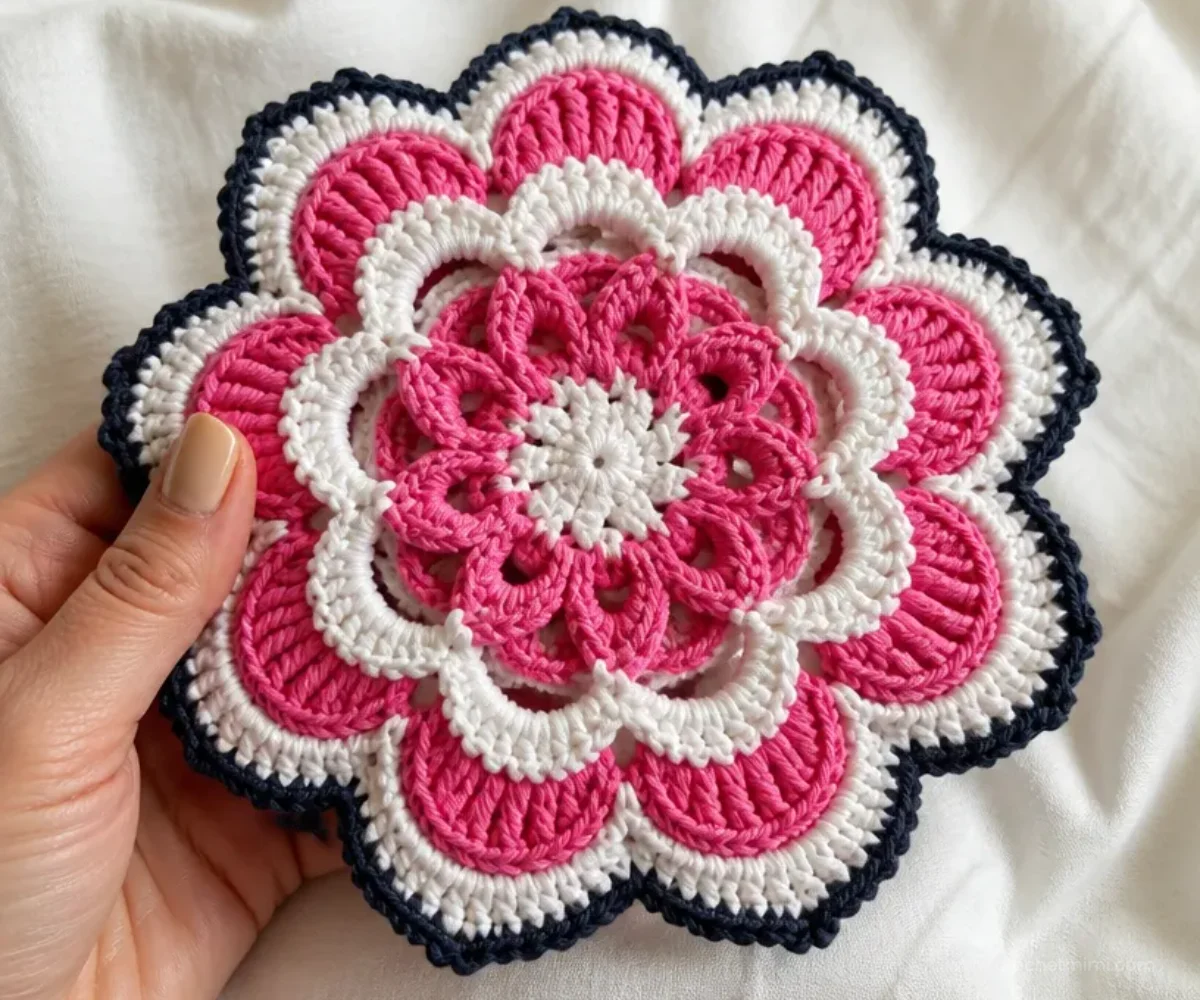
- Make a small vase arrangement. Group several finished flowers in coordinating shades for a permanent tabletop display.
- Create a gift accent. Sew or tie one flower onto ribbon, a wrapped package, or a handmade card.
- Build a seasonal centerpiece. Snow, rose, and night can suit spring displays as well as winter-inspired arrangements.
- Combine different flower shapes. Pair this layered bloom with crochet red roses for contrast between open petals and tightly shaped blooms.
- Decorate a textile project. Attach the flower to a bag, hat, scarf, or cushion only after considering how the added texture will affect use and cleaning.
- Use it as a flat botanical accent. A single flower can be arranged beside a framed print, candle display, or small crochet doily such as this mandala crochet doily design.
Caring for Your Crochet Project
Patons® Grace is a delicate crochet yarn, and the flower includes several raised petal layers that can catch or flatten if handled roughly. Keep the finished piece away from excessive heat, sharp objects, and heavy pressure.
For routine care, gently dust the flower with a soft brush or use careful bursts of cool air from a distance. If a small area becomes soiled, spot-clean it cautiously rather than soaking the whole flower. Test any cleaning approach on a concealed section first.
To restore the shape, separate the petal layers with your fingers and ease each petal outward. Avoid pulling sharply on the edging or the chain spaces supporting the outer rounds. Store the flower flat or in a box with enough room to prevent crushing.
Tips for Better Results
- Keep the center ring secure. Join the starting chain with a neat slip stitch so the first round does not loosen while you work.
- Watch the picots. In the second round, the slip stitch goes into the third chain from the hook to form each picot.
- Work behind the correct round. Rounds 5, 7, and 9 use spaces from earlier rounds, not the most recently completed petal edge.
- Identify the middle tall stitches. The instructions place anchoring single crochets between the center 2 dc or center 2 tr. This positioning helps the next layer sit evenly.
- Do not count non-stitch chains. The chains at the beginning of rounds 5, 7, and 9 are specifically marked as not counting as stitches.
- Shape petals as you go. After each petal layer, gently spread the groups of stitches so you can see whether the five sections are evenly spaced.
- Join new colors carefully. When joining MC, Contrast A, or Contrast B, place the slip stitch into the stated space or stitch and keep the new yarn from twisting.
- Finish ends securely. Fasten off after the rounds that specify it, then weave in ends discreetly without tightening the flower’s center.
For more floral inspiration, a full blooming bouquet crochet blanket can help you explore how individual flower motifs work together in a larger botanical design.
Color and Styling Variations
The approved pattern uses Snow, Rose, and Night, but the color arrangement can be adapted as an optional styling choice.
- Soft garden palette: Replace the Rose effect with a pale pink or lavender yarn while keeping Snow as the main color.
- Bold contrast: Use a saturated jewel tone for Contrast A and a dark or black shade for Contrast B.
- Sunset flower: Choose warm cream, coral, and deep burgundy shades for a richer arrangement.
- Monochromatic bloom: Use three shades of one color family to emphasize the layered shape without strong color breaks.
- Mixed bouquet: Make several flowers with different main and contrast colors, then arrange them together in groups of odd numbers.
- Textured display: Combine the flower with crochet leaves or other botanical motifs, provided they are made separately and do not alter this approved pattern.
If you substitute yarn or change the hook size, the flower’s dimensions, petal stiffness, drape, and yarn requirements may change. Keep the same stitch instructions, but expect the finished shape to vary with the new materials.
Frequently Asked Questions
Is this crochet flower pattern suitable for beginners?
It can be a useful learning project for a confident beginner who is comfortable with basic crochet stitches and working in rounds. The layered construction and behind-the-petal anchoring require careful attention to placement.
What yarn does the pattern recommend?
The pattern specifies Patons® Grace, 50 g/1.75 oz, in three colors: Main Color 60005 Snow, Contrast A 60437 Rose, and Contrast B 60040 Night. One ball of each color is listed.
How many petals does the flower have?
The center structure establishes five petals, and the visible petal rounds are also worked in groups of five. The pattern specifically identifies five petals after the relevant rounds.
Can I change the colors?
Yes. Changing colors is an optional customization. Preserve the pattern’s color-change sequence if you want the same layered contrast, or choose a different palette while keeping track of MC, Contrast A, and Contrast B.
Why are some rounds worked behind an earlier petal layer?
Working behind the previous layer creates new chain spaces that support the next set of larger petals. This is what gives the flower its dimensional, layered appearance.
How should I keep the petals evenly spaced?
After each petal round, check that the five groups are distributed evenly around the center. Before fastening off, gently arrange the petals and confirm that none of the anchoring spaces have been skipped.
Can I use another yarn?
A different yarn may work, but it can change the flower’s size, firmness, drape, and overall petal definition. Match the yarn weight and choose a hook appropriate for that yarn, then treat the result as an optional variation.
How should I care for the finished flower?
Dust it gently, spot-clean cautiously when needed, and store it where the layered petals will not be crushed. Avoid excessive heat and rough handling.
Conclusion
This layered crochet flower pattern combines graceful petal shaping with a striking three-color palette. Follow each behind-the-layer anchoring instruction carefully, then arrange the finished bloom as a decoration, gift accent, or part of a handmade bouquet. For more ideas, explore these free crochet flower patterns and this simple crochet flower tutorial for additional floral inspiration.